Jan Whitaker's Consumer Society


THE TOP 35 STORES IN SALES VOLUME, 1963-1964 (Source: Inside the Fashion Business, 1965)

1 Macy's, New York City

2 Hudson's, Detroit

3 Marshall Field, Chicago

4 Abraham-Straus, Brooklyn

5 May's, Los Angeles

6 Carson Pirie Scott, Chicago

7 Bamberger's, Newark

8 Alexander's, New York City

9 Goldblatt Brothers, Chicago

10 Famous-Barr, St. Louis

11 Emporium-Capwell, San Francisco

12 Broadway Department Store, Los Angeles

13 Bullocks, Los Angeles

14 Filene's, Boston

15 Bloomingdale's, New York City

16 Dayton's, Minneapolis

17 Jordan Marsh, Boston

18 Wanamaker's, Philadelphia

19 Gimbels, New York City

20 Rich's, Atlanta

21 F&R Lazarus, Columbus

22 Strawbridge & Clothier, Philadelphia

23 May's, Cleveland

24 Woodward & Lothrop, Washington DC

25 Lit Brothers, Philadelphia

26 B. Altman, New York City

27 Hecht's, Washington DC

28 Kaufmann's, Pittsburgh

29 L. S. Ayres, Indianapolis

30 Joseph Horne, Pittsburgh

31 Shillito's, Cincinnati

32 Stix, Baer & Fuller, St. Louis

33 Gimbels, Philadelphia

34 Higbee's, Cleveland

35 Rike-Kumler, Dayton


To read about my book on department stores, Service and Style, click here.

Department Store History
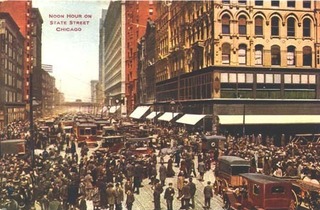

Noontime on State Street, with Mandel Brothers on right and Marshall Field's granite exterior in the distance.
If you had been a typist working in Chicago's Loop at this time, around 1910, you would have eaten your lunch as quickly as possible and run off to one or more of the department stores that lined State Street. Daily visits to their busy aisles and counters were commonplace, and many suburban women rode the streetcars several times a week to shop in them. There were sales every day, some days every hour. And if you decided you didn't like your purchase, you knew you could return it. The customer was always right, as much as it pained the stores to take back great volumes of merchandise.
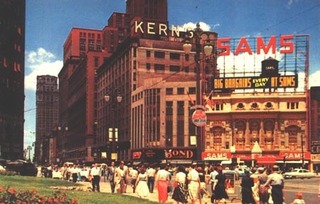


Woodward Avenue, Detroit, with Kern's and then Hudson's looming in the distance.
How the mighty have fallen. Hudson's, once the second largest department store in the country in terms of sales, no longer exists, its flagship store imploded into smithereens years ago. To say it was mighty is no exaggeration. In 1947 its 16 selling floors contained Detroit's largest bookstore, largest drugstore, and largest toystore.
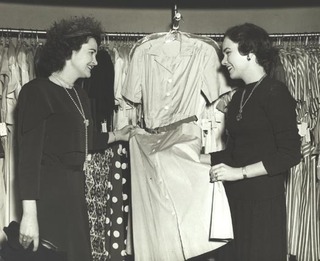


Famous-Barr, Clayton branch, opened 1948.
Famous-Barr in St. Louis was one of the flagship stores of the May Company which owned department stores all over the country -- until its recent absorption by Federated Department Stores. The branch store in Clayton was entirely new and modern when this photograph was taken.


Selected Works

Department Store History Book
Service and Style: How the American Department Store Fashioned the Middle Class
An examination of the buildings, people, merchandise, show windows, parades, and hoopla that made the big-city American department store so memorable.
Essay in Book
"Domesticating the Restaurant"
Explores women's impact on the 20th century restaurant industry (UMass Press).
Essay in Magazine
"Quick Lunch"
Gastronomica article on the country's first fast food eateries which got their start in the 1880s.
Tea Room History Book
Tea at the Blue Lantern Inn: A Social History of the Tea Room Craze in America
From Greenwich Village and the New England roadside of the 1920s to the Gypsy tea rooms of the Depression, running small tea rooms provided a new occupation for women.


Find Authors

Created by The Authors Guild

A note for users of older versions of Internet Explorer, Netscape, or AOL:
This site will look a lot better in a newer browser. Download one for free!
Internet Explorer: Windows Mac   |   Netscape: Windows Mac Other
For AOL users, please choose Internet Explorer above.