Consumer HistoryWe rarely think about how much our lives are shaped by consumer institutions such as restaurants and department stores. And yet they loom large in our activities and memories and form part of our sense of place and occasion. In universities, scholars now debate whether consumer choices are forced upon us by a manipulative culture or freely chosen by individuals crafting their identities through the goods they buy. I've found in my research of historic tea rooms, quick lunches, restaurants, and department stores, that there is some truth in both positions. As consumers we experience freedom and manipulation. Department stores were the first big commercial entities to zero in on the child consumer, speak directly to them, and create an enticing world of goods for them. They routinely featured fashion shows for teenage girls that depicted contrasting "teenage misses" and "teenage messes," the latter being girls who did not heed fashion or wear the right makeup. At the same time, department stores offered a wide range of Americans their first taste of art and design. In the 19th century, department stores were showcases for electric lighting, elevators, and telephones. Many shoppers had their first restaurant meal in a department store tea room or their first ride on an escalator. Immigrants learned about their new world by working as clerks or by browsing in stores to see how Americans lived. Around 1900 department stores in the big cities were popular tourist sites, and even today many visitors to New York City head straight to Macy's. ![]() Donaldson's Glass Block store, Minneapolis ca. 1905 |
My Books, etc.Service and Style: How the American Department Store Fashioned the Middle Class
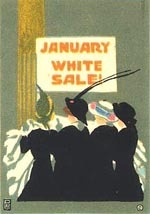
St. Martin's Press, 2006. 352 pages, well illustrated. ![]() ca. 1915 poster stamp The history of downtown department stores is as fascinating as their names and as diverse as their merchandise. Their stories encompass many themes: the rise of decorative design, new career paths for women, the growth of consumerism, and the technological ingenuity of escalators and pneumatic tubes. Just as the big stores made up their own small universes, their stories are microcosmic narratives of American culture and society. For more about this book, click here. Tea at the Blue Lantern Inn: A Social History of the Tea Room Craze in America
St. Martin's Press, 2002. 240 pages, well illustrated. The Gypsy Tea Kettle, Polly's Cheerio Tea Room, The Mad Hatter, and The Blue Lantern Inn (there were at least three with this name) are just a few of the many tea rooms of the early 20th century. Most were owned and operated by women and most of the patrons were women too. By the 1920s, the country was almost swamped with tea rooms. Sparked by National Prohibition, the suffragist movement, and the rise of the automobile, tea rooms forever changed the way America eats out, and laid the groundwork for the modern small restaurant and coffee shop. For more about this book, click here. "Quick Lunch"
Appears in Gastronomica, Winter 2004, pp. 69-73. Describes the simple fare and basic amenities found in America's first chain restaurants, dubbed variously quick lunches, dairy lunches, or lunch rooms. Cereal with milk was one of their top sellers. Unlike in our 20th century fast-food places, hamburgers were not often served. For more about this article and about quick lunch places, click here. "Domesticating the Restaurant"
Chapter in From Betty Crocker to Feminist Food Studies, edited by A. Avakian and B. Haber, Amherst: University of Massachusetts Press, 2005. When women entered the restaurant business in the 20th century, they brought with them new kinds of dishes such as salads, stuffed tomatoes, and layer cakes, as well as decor featuring plate rails, crockery collections, and hand-sewn curtains. They also championed a higher level of sanitation, measured against the standards of the middle-class home. For more about this article and about women and restaurants, click here. |
|
Created by The Authors Guild
A note for users of older versions of Internet Explorer, Netscape, or AOL:
This site will look a lot better in a newer browser. Download one for free!
Internet Explorer:
Windows
Mac
|
Netscape:
Windows Mac Other
For AOL users, please choose Internet Explorer above.